Friday, October 25, 2013

Choice List 2005

The Giver
by Lois Lowry
Published by Houghton Mifflin Company
Copyright 1993

Reading Level: Lexile Level 760L, reading level 6

Suggested Delivery: Independent read, read aloud

Vocabulary: palpable (3), transgression (9), droning (22), chortled (33), prodded (41), buoyancy (47), aptitude (52), benign (59), throng (65), admonition (89), daub (109), wisp (125), horde (133), ruefully (141), imploringly (142), languid (166), taut (168), flagging (172)

Awards: 1994 John Newbery Medal, ALA Notable Children's Book, ALA Best Book for Young Adults 
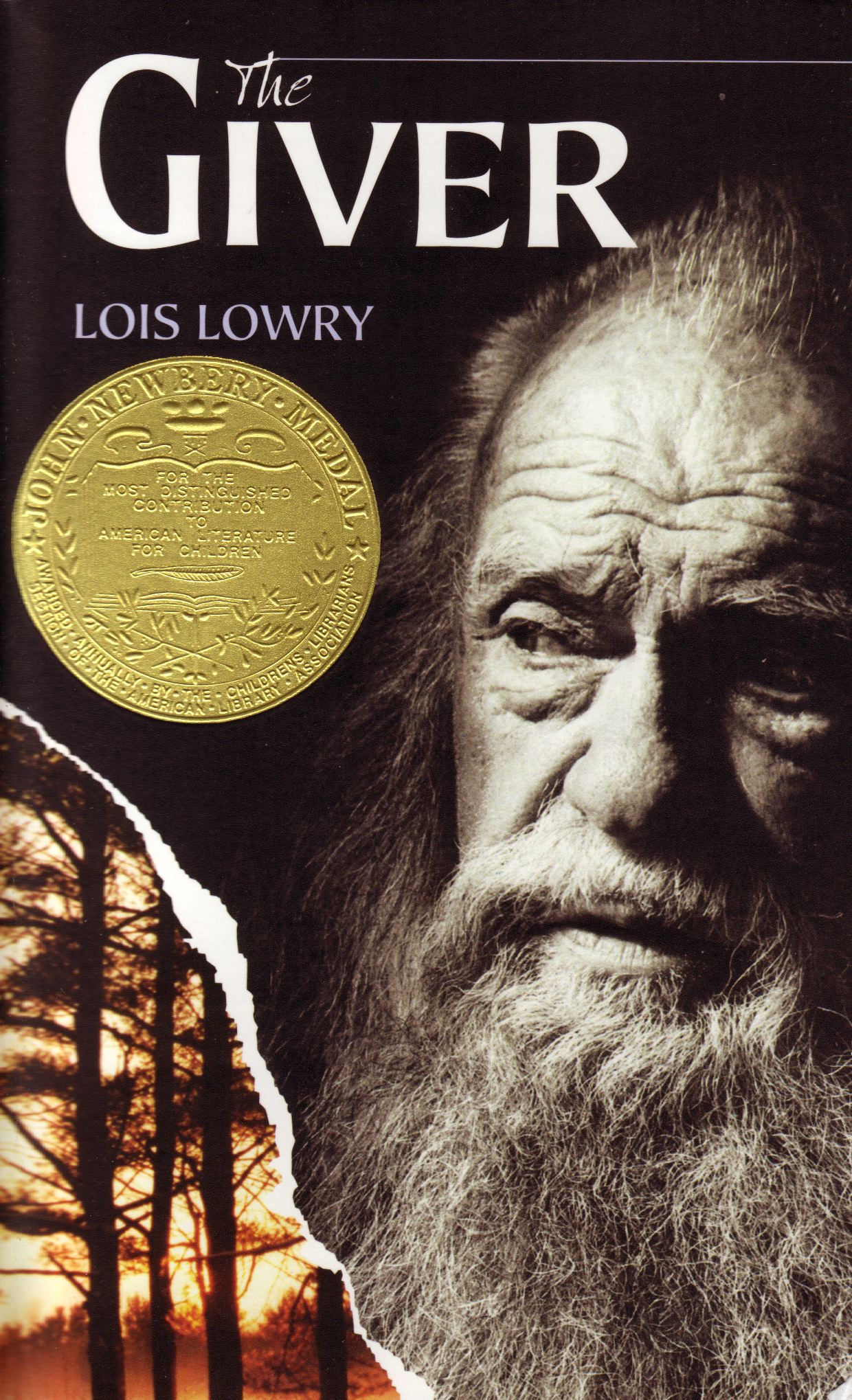
"'It was almost December, and Jonas was beginning to be frightened.'"
Thus opens this haunting novel in which a boy inhabits a seemingly ideal world: a world without conflict, poverty, unemployment, divorce, injustice, or inequality. It is a time in which family values are paramount, teenage rebellion is unheard of, and even good manners are a way of life.
December is the time of the annual Ceremony at which each twelve year old receives a life assignment determined by the Elders. Jonas watches his friend Fiona named Caretaker of the Old and his cheerful pal Asher labeled the Assistant Director of Recreation. But Jonas has been chosen for something special. When his selection leads him to an unnamed man -the man called only the Giver -he begins to sense the dark secrets that underlie the fragile perfection of his world.
Told with deceptive simplicity, this is the provocative story of a boy who experiences something incredible and undertakes something impossible. In the telling it questions every value we have taken for granted and reexamines our most deeply held beliefs."- Amazon. com

The Giver is challenging, mysterious, and an unforgettable read. The book leaves an open mind for the reader to fill in the structure because the concepts are never really explained. This keeps the reader hooked and excited to read on to find out why.  


Pre-Reading Activity: Make a list on chart paper or on the board of what the students believe are elements involved in a eutopia. After defining that the world means a perfect world the students can each add their one of their own components to what makes up a utopia. Tell the students that their ideas should not just be personal, but should be universal as well. Introduce the story with telling the students that the utopia in the story takes a very wrong turn. 

During Reading Activity: As the students read, they can keep in mind the following key question, "Do you think Jonas could have found a way to share his new experiences with his friends and family? Should he have done it this way? Why or why not?" This question can be asked after the students have read chapter 12.

Post Reading Activity: Jonas's community had roles assigned to each person living in their utopia. Have the students pretend they're in that type of utopia. The students can pick three friends and choose which role to assign to their friend. Students can get into small groups and explain why they chose those roles for their friends. 

Writing Activity: Students can make a small list of four to five choices that are important to them. After making their list students can write a paragraph based off the question, "How would you feel if those choices were taken away from you? What would you do to get them back? Explain why these choices are very important to you."

Electronic Resources:

The Giver Quiz
For students who like a little more
of a challenge, this is a 10 question online 
quiz for students who would like to take it
on their own time. This can also be an electronic
option for students who feel overwhelmed when
taking paper based tests. There are options to take
four different quizzes, summaries of all the chapters, 
and a list of major themes and quotes.

Fake Trailer for The Giver
This is fake trailer created by student in an 8th
grade class. The movie "The Giver" will be released
in 2014 with Taylor Swift playing the role of Rosemary. 
Students can watch this trailer and dicuss whether it was 
accurate or a good prediction for what the movie
might look like. This can be a good pre reading activity
as well to get students hooked in wanting to see the movie
and read the book as well.  


AfDoT  youare his new experiences

Tuesday, October 22, 2013

Graphic Novel

A Family Secret 
by Eric Heuvel
Published by Square Fish
Copyright 2007

Reading Level: Lexile level GN400L, reading level 3.3

Suggested Delivery: Independent read

Vocabulary: chancellor (10), abolish (12), unemployment (12), neutrality (15), resign (24), ideology (26), solemn (26), resent (41), resistance (41), ration (43), courier (45), liberated (45)  
Awards: Dutch Comics Association category award, Sydney Taylor notable book for teens 2010

Eric Heuvel; Translated by Lorraine T. Miller A Family Secret
"While searching his grandmother’s attic for likely items to sell at a yard sale, Jeroen finds a photo album that brings back hard memories for his grandmother, Helena. Helena tells Jeroen for the first time about her experiences during the German occupation of the Netherlands during the Second World War, and mourns the loss of her Jewish best friend, Esther. Helena believes that her own father, a policeman and Nazi sympathizer, delivered Esther to the Nazis and that she died in a concentration camp. But after hearing her story, Jeroen makes a discovery and Helena realizes that her father kept an important secret from her."- Amazon.com

This novel is informational, engaging, educational, serious, and takes young readers step-by-step through a tough time period.

Pre-Reading Activity: Students can dicuss with the teacher what they already know about the Holocaust and the event that occurred during the tragic time. The teacher can introduce the story by explaining why they're going to read a graphic novel. Graphic novels are a very good genre for introducing young audiences to historical events they might avoid. The pictures speak to a kind of print because it may take many words to say what points and messages the author wants to get across to their readers.

During Reading Activity: As students read they can ask themselves following questions, "Why did Helena prefer being at Ester's house to bring at her own house?" "Would you have supported Helena's father's decision if he was your own father?". These questions can be used in a bookmark for the novel.

Post Reading Activity: Students can imagine the school principal just created a new policy that everyone must attend school on Saturdays. Students can divide into small groups and dicuss with their classmates the likelihood of eveyone accepting this new policy. Students can make a list of feelings they would have and maybe some actions they would take against the new policy. Students can then come together as a whole class are share their lists with the other groups. 

Writing Activity: Students can write a few paragraphs on the following question, "The Nazis got rid of some human rights in every place they took over. Think about some rights that you have: the right to go to school, the right to see a doctor, the right to go to the movies and shop. What rights would be hardest for you to lose? What rights would be the easiest for you to lose? Why?" 

Electronic Resources: 

World War II History for Kids
This website can be very informational
for students who wish to learn more 
about the Holocaust and the events 
involved in it. This website helps ease
in young children into the tought subject
of the Holocaust through helpful vocabulary definitions, pictures, links to timelines, and other helpful links to learn more about World War II. 


Graphic Novels for Kids
This website is very helpful for students 
if they really enjoyed reading this type of genre.
It includes not only a list of other graphic novel
that kids would enjoy, but it also lists  graphic
novels that students can find in their own library. 
Each book has a brief decription of the novel just in
case students are looking for a particular storyline, 
characters, or other element.

Monday, October 21, 2013

Newbery Winner

The One and Only Ivan
by Katherine Applegate
Published by HarperCollins Publishers
Copyright 2012

Reading Level: Lexile level 570L, reading level 3.3

Suggested Delivery: Read aloud

Vocabulary: domain (7), shakles, ponder, lingered, precision, clutch, wily

Awards: John Newbery Medal 2013, Kind Wings Top Flight Award 2013 


"Ivan is an easygoing gorilla. Living at the Exit 8 Big Top Mall and Video Arcade, he has grown accustomed to humans watching him through the glass walls of his domain. He rarely misses his life in the jungle. In fact, he hardly ever thinks about it at all. Instead, Ivan thinks about TV shows he’s seen and about his friends Stella, an elderly elephant, and Bob, a stray dog. But mostly Ivan thinks about art and how to capture the taste of a mango or the sound of leaves with color and a well-placed line. Then he meets Ruby, a baby elephant taken from her family, and she makes Ivan see their home—and his own art—through new eyes. When Ruby arrives, change comes with her, and it’s up to Ivan to make it a change for the better. Katherine Applegate blends humor and poignancy to create Ivan’s unforgettable first-person narration in a story of friendship, art, and hope."- Amazon.com
This story is heartwarming, unforgettable, personable, sentimental, and understanding. Readers of all ages will be able to connect to Ivan's unforgettable journey and learn from his experiences. 
Pre-Reading Activity: The Atlanta Zoo website has a wonderful page about Ivan and his life in the Zoo. There's a video, facts, and stories about Ivan's life in the Zoo. Students can watch the video on the website's page before starting to read the story. Knowing that Ivan was a real gorilla can help spike students' interests in the story. 
During Reading Activity: As they students read they can think about the following questions, "If you were Ivan, how would you feel about where you were living?" "When Ivan his best friend, did he give up hope on saving Ruby?" "How would you feel? Would you still keep your promise?"

Post Reading Activity: After reading the story, students can be divided into small groups and asnwer some group discussion questions. Questions can include, "What did you think of the ending? Were you happy with it?" "Would you have changed anything in the story?" "If Ruby was no longer a character in the story would it change for you? Why or why not?"
Writing Activity: For a writing activity students can answer inferential questions about specific quotations in the book. The teacher can cut out 10 pages of the story and pick 2 of 3 quotes from that section. Students will then have to answer questions inferentially partaining to each quote. For example the teacher can take the quote, "Right now I would give you all the yogurt raisins in the world to have a heart made of ice," (page 114). Students can answer the question, "What does this tell you about Ivan's feelings? Explain what this means."

Electronic Resources: 

Zoo Atlanta: Celebrating Ivan
This is the website used as a pre-reading
activity. If students were interested, they 
can go to this website and see how Zoo 
Atlanta, Ivan's new home, celebrated his life
after he died in 2012. The webpage includes
facts about Ivan's life, the video of Ivan interacting with other gorillas, and pictures of Ivan as well.

The One and Only Ivan Book Trailer
This website can also be helpful to spark students' 
interest in the book. Complete with music, pictures 
from the text, and text to read this video can make
students feel like they are about to watch a movie
instead of reading a book. This is what caught my
attention to the novel and can be very helpful when 
grabbing students' attention to the novel as well. 


Thursday, October 17, 2013

Newbery Winner

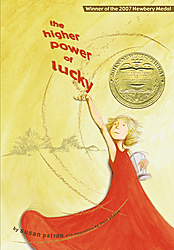
The Higher Power of Lucky
By Susan Patron
Published by Simon & Shuster Children's Publishing Division
Copyright 2006

Reading Level: Lexile 1010L, reading level 5.5

Vocabulary: splendiferous (2), antivenom (4), crevices (6), capillaries (17), enzymes (19), pension (23), inventory (26),  commodities (35), secretions (68)

Awards: John Newbery Medal 2007

"Lucky, age ten, can't wait another day. The meanness gland in her heart and the crevices full of questions in her brain make running away from Hard Pan, California (population 43), the rock-bottom only choice she has.
It's all Brigitte's fault — for wanting to go back to France. Guardians are supposed to stay put and look after girls in their care! Instead Lucky is sure that she'll be abandoned to some orphanage in Los Angeles where her beloved dog, HMS Beagle, won't be allowed. She'll have to lose her friends Miles, who lives on cookies, and Lincoln, future U.S. president (maybe) and member of the International Guild of Knot Tyers. Just as bad, she'll have to give up eavesdropping on twelve-step anonymous programs where the interesting talk is all about Higher Powers. Lucky needs her own — and quick.
But she hadn't planned on a dust storm.
Or needing to lug the world's heaviest survival-kit backpack into the desert."- Powell's Books

This book is comforting, smooth, endearing, believeable, and colorful story. Susan Patron has highlighted the surrounding characters so each one stands alone, but also helps define, strengthen, and deeply connect the reader to Lucky.

Pre-Reading Activity: Before reading the story, students can have a class discussion with the teacher about what the students think a Higer Power is. The teacher can mentioned how during the story Lucky is searching for a Higher Power and students can have an opinionated talk with the teacher about what looking for a Higher Power means to them.

During Reading Activity: As students read the story, the can ask themselves the questions included on a "Higher Power of Lucky" bookmark provided for each student.

Post Reading Activity: After reading the story, the students can discuss in groups of 2-3 what the story would be like if Lincoln was no longer a character. Students can discuss how the story would change and how that would make them feel. 

Writing Activity: Students can answer the following question in a few paragraphs, "Do you think Lucky could solve her problem in another way?  What do you think would be a better plan than running away?" This assignment can be collected and used as an assessment of the students' understanding of the novel.

Electronic Resources: 

This website The International Guild of Knot 
Tyers (of which Lincoln was one of the youngest 
members) has a Beginners section which shows 
pictures and names of various types of knots and 
provides instructions for tying them. This can 
give students an idea for what Lincoln was
interested in. 


Wednesday, October 16, 2013

Book of Poetry

Doodle Soup
By John Ciardi
Published by Houghton Mifflin Company
Copyright 1985

Reading Level: Reading level 4

Suggested Delivery: Read aloud, independent read

Vocabulary: pedigreed (5), steeple (10), douse (11), chap (18), precisely (28), seldom (32), remarkable (48), various (54)

Awards: NCTE Award for Excellence in Poetry for Children in 1985

"Here is a delicious bowlful of nonsense and wisdom, cautionary tales and fantastic adventures. Master poet John Ciardi warns the dangers of taking baths:

Jimmy Jones was skin and bones.
The bone was mostly in his head.
He used the skin to take baths in,
But he caught cold and now
he's dead...

He gives lessons in manners

Someone told me someone said
You should never be bad until you've
been fed...

He explains why pigs cannot write poems, what happened when the ice cream truck got stuck, and the trouble when catching a bull moose ("It's mean. And also large.") Merle Nacht's zany illustrations perfectly capture the high-spirited humor of this lively collection."

This compliation of poems is humerous, entertaining, silly, relateable, and creative. This book of poems is a good read for children of all ages!

Pre-Reading: Befor reading the poems, the students can predict what the story can be about based on the title. Sometimes, creating reading lessons for a poetry book is difficult because the poems to follow the basic storyline and can sometimes be all over the place. The students can predict what the different poems may be about and even make their own predictions about what "doodle soup" is. Whether the students take the title literally or figurtively is up to them. Poetry involves opening up the mind and thinking outside the box. What is on the page may not be what the poem is really about. Encourage the students to think creatively when reading these poems and when predicting what the poems may be about. 

During Reading: As students read, they can mark down their favorite poems. They can choose the poems because they can relate to it, it was well written, or because it put a smile on their face. As students mark down their favorite poems they can keep in mind the question, "What was that poem really about?"

After Reading: This collection of poems includes a lot of fluency and rhyming words. After reading, the students can join together as a whole class and pick out two words in any poem they want that rhymed together. After each students has picked their two rhyming words, they can write them in marker on a sheet of chart paper. The teacher can then cut the words out and put them together on rhyming word bulliten board. When students wish to add more  rhyming words they will read in future stories, they can add them to the board. This way the board can continue to expand throughout the year.

Writing Activity: Students can write their own wacky, crazy poem just like the ones in the book. The students can make the poem a few lines long and then write a small description of what the poem is about and why they decided to write the poem about whatever topic they chose. Students can share these with the whole class or in small groups. 

Electronic Resources:

Rhyme Zone
This website can give students an
idea of rhyming words and that many 
words have rhyming words. This website 
allows students to type in any word, click
search, and any word that rhymes with 
the word they type in will pop up. They 
can also use this website to find definitions, 
synonyms, antonyms, consonants in the 
word, and many more. The website also
includes an option to organize the words 
by syllables or letters.

Poetry 4 Kids
This website is super fun for kids to 
learn how to write simple, but fun
poems. This website also includes 
fun poems, podcasts, dictionaries, 
and other fun resources to help
student learn that poetry is a fun
and silly way to write about 
anything!


Wednesday, October 9, 2013

Historical Fiction

The Boy in Striped Pajamas
By John Boyne
Published by Random House Children's Books
Copyright 2007

Reading Level: Lexile Framework 1080L , reading level 8.3

Suggested Delivery: Independent read, Read aloud 

Vocabulary: dismissively (8), laquer (42), oblige (61), incredulous (64), coincide (87), anti-semitism 

Awards: Irish Book Award Children’s Book of the Year, Irish Book Award People’s Choice Book of the Year, Bisto Book of the Year, Que Leer Award Best International Novel of the Year (Spain), Orange Prize Readers Group Book of the Year

The Boy in the Striped Pajamas: John Boyne "Berlin 1942
When Bruno returns home from school one day, he discovers that his belongings are being packed in crates. His father has received a promotion and the family must move from their home to a new house far far away, where there is no one to play with and nothing to do. A tall fence running alongside stretches as far as the eye can see and cuts him off from the strange people he can see in the distance.But Bruno longs to be an explorer and decides that there must be more to this desolate new place than meets the eye. While exploring his new environment, he meets another boy whose life and circumstances are very different to his own, and their meeting results in a friendship that has devastating consequences."- Amazon 

This book is a heart warming, insprirational, powerful, memorable, and realistic portrayal of the Holocaust. This book does a great job with helping students understand and that being different should have no influence on friendship. 

Pre-Reading: Students can participate in a writing activity that will activate their thinking about the theme of friendship. Questions for the activity can include, "Describe the traits of a good friend", "Have you ever been betrayed by a friend?", Do you have an enemy? What makes somone an enemy?", "Have you ever been friends with someone you were not supposed to be friends with? Why were you not allowed to be friends with that person?" This activity will provide students a hook for the story. After responding to the pre-reading questions, students will share with their partners.

During Reading: As students read the story, they come across many barriers and issues that Bruno must deal with that affect his life. Students can keep a mental list of these barriers, or write them out. Students can ask themselves the questions, "What are these problems? How do these barriers affect Bruno's decisions? How does Bruno overcome these problems?" "How do Bruno and Shmuel avoid the soldiers and parents in order to keep their friendship?"

Post-Reading: Students can watch the movie "The Boy in Striped Pajamas" that released on November 2008. After watching the movie students can create a Venn diagram, comparing and contrasting events in the story and events in the movie. After creating their Venn diagrams, students can pair up and compare and contrast their Venn diagrams with their partners.

Writing Activity: In a couple paragraphs students can write about how the book affected them, in postive ways and/or in negative ways. They can also write about whether or not they would recommend the book to others and why or why not. This can be a good acitivty to use as an assemement for the lesson. 

Electronic Resouces: 

This vocabulary list includes more vocabulary
words for students to understand while 
reading the novel. The list includes the word, 
the definition of the word, other forms of the word,
and even easy ways to remember the vocabulary word.

"The Boy in Striped Pajamas" Trailer
This Youtube video of "The Boy in Striped Pajamas"
trailer can give students an extra look at the movie
and what it entails. If students would like to watch
the movie at home with their families, it is available online
and on Netflix. 


Wednesday, October 2, 2013

Book of Diversity

Rules
by Cynthia Lord 
Published by Scholastic Inc.
Copyright 2008

Reading Level: Lexile Framework 780L, reading level 4

Suggested delivery: Independent read, read aloud

Vocabulary: fray (8), cringe (25), wince (67), accommodate (69), peril (95), discards (181)

Awards: Newberry Honor Medal, Schneider Family Book Award, Mitten Award, Great Lakes Great Book Award (MI), Maine Student Book Award, Dorothy Canfield Fisher Award (VT), Kentucky Blue Grass Award, Great Stone Face Award (NH), Buckeye Children's Book Award (OH)


"Twelve-year-old Catherine just wants a normal life. Which is near impossible when you have a brother with autism and a family that revolves around his disability. She's spent years trying to teach David the rules — from "a peach is not a funny-looking apple" to "keep your pants on in public" — in order to stop his embarrassing behaviors. But the summer Catherine meets Jason, a paraplegic boy, and Kristi, the next-door friend she's always wished for, it's her own shocking behavior that turns everything upside down and forces her to ask: What is normal?" - Scholastic.com

This book is a heartwarming, humerous, eye opening, realistic, and age appropriate read for students to understand that being different and feeling different is a part of life. This novel can be relateable in many different ways and can help students find acceptance in their own differences.


Pre- Reading: Talk to the students about how there are similarities and differences amoung people. Make a list on the board of differences that students have (wear glasses, only child, hair length, etc.). Then discuss with the students that there are other types of differences that people can have. Tell them that there are students' who's brains work differently than ours, some who need to sit in chairs because they can't walk, or weren't born with the ability to speak or hear. Make sure the students understand that just because they are different, does not make them wierd or outcasts. Tell them that Catherine's brother, David, has autism which means that his brain sometimes does not understand things as easily as we do. Then mention that the character Jason cannot speak, so he uses different items to communicate with his family and friends. 

During Reading: As students read, the students could pause at certain intervals to consider what it would be like to have to take care of a sibling with autism and how they would feel: Would I be embarrased? Would I feel frustrated? Could they do the same things I do? What rules would I make?

Post Reading: After reading, the teacher could discuss with the students how Catherine dealt with having to take care of David. The students could list off a few things that David did with Catherine and how Catherine handled the situations, especially if they were in public. The students could then discuss how they would deal with certain situations, such as if David started yelling how would they try to calm him down and relax him?

Writing Activity: Students could create their own list of rules for David. The students can write a few rules they remember Catherine wrote down in the story and then tell the students to come up with two to three of their own rules for David. After creating the rules the students can explain in a few sentences why their rule would be helpful for someone like David. 

Electronic Resources: 

Students may not understand or might not even be aware of what morse code is. Explain to the students that morse code is a way of  communication for people who cannot speak that is made up of just dots and dashes. Jason used morse code to communicate with people, as well as some noisy objects. This morse code converter is very helpful for students who wants to quickly find out what certain words, sayings, or sentences are in morse code. This website could also be very helpful for those who would like to communicate with someone who cannot speak, such as a family member or another students in their classroom. 


Cynthia Lord, the author of Rules, has her own website with multiple different cites and resources for students and teachers based off Rules and her other books. This specific link includes the background story to Cynthia's reason behind writing Rules and also includes online resources connected to parts of the book.